Musicians for Liverpool: The City That Taught the World How to Listen
Liverpool did not just produce successful musicians. It created entire movements, rewrote the rules of popular culture, and turned a working port city on the River Mersey into one of the most influential musical capitals in history.
Long before streaming platforms and global playlists, music travelled into Liverpool through its docks. Sailors returned from New York carrying rhythm and blues records, early rock and roll singles, jazz imports, and soul music unavailable elsewhere in Britain. Those sounds filtered through dance halls, pubs, cellar clubs, youth clubs, church halls, and smoky basements, eventually shaping a sound that would travel back out across the world.
In 2001, Guinness World Records officially recognised Liverpool as the “World Capital City of Pop”, but for generations of musicians and fans, the title had already been earned.
The Beatles and the Sound That Changed Everything
Any story about Liverpool music begins with four young men who transformed modern culture.
John Lennon, Paul McCartney, George Harrison, and Ringo Starr did more than form a band. Together, the Beatles changed songwriting, recording, fashion, youth identity, and the global music industry itself.
The group’s roots stretch back to 1956, when Lennon formed the Quarrymen while attending Quarry Bank High School. McCartney joined a year later, Harrison soon after, and by 1962 the classic line-up was complete. Before worldwide fame arrived, the band spent years performing in Liverpool clubs and in Hamburg’s notorious Reeperbahn district, where marathon performances sharpened both their musicianship and stagecraft.
Then came Beatlemania.
From Please Please Me to Abbey Road, the Beatles evolved at a pace popular music had never seen before. Albums such as Rubber Soul, Revolver, Sgt. Pepper’s Lonely Hearts Club Band, and The White Album pushed recording technology and songwriting into entirely new territory.
The statistics remain staggering:
- More than 600 million records sold worldwide
- 20 US Billboard number-one singles
- 18 UK number-one singles
- The best-selling and most influential band in popular music history
Yet Liverpool never feels distant from the Beatles story. It is written directly into the city itself.
Penny Lane still exists. Strawberry Field still draws visitors. The childhood homes of Lennon and McCartney remain pilgrimage sites for music fans from around the world. Even decades after Lennon’s murder in 1980 and Harrison’s death in 2001, the city continues to carry their legacy in its streets, accents, humour, and attitude.
In 2023, the Beatles returned to number one in the UK charts with “Now and Then”, promoted as the final Beatles song after AI-assisted audio restoration helped complete an unfinished Lennon demo. More than sixty years after Beatlemania began, Liverpool’s most famous band was still making history.
Merseybeat and the Explosion of a New Sound
The Beatles were never a one-off phenomenon. They emerged from a city overflowing with bands.
By the early 1960s, Liverpool’s music scene had become one of the most active anywhere in Europe. Hundreds of groups were performing across the city every week, fuelled by a mixture of American rock and roll, rhythm and blues, skiffle, jazz, and traditional British pop songwriting.
The movement became known as Merseybeat, named after the River Mersey and popularised by Bill Harry’s influential local music newspaper Mersey Beat.
Liverpool’s status as a global port gave local musicians unusual access to imported American records. Merchant seamen, often referred to locally as “Cunard Yanks”, brought home the latest singles from the United States months before they appeared elsewhere in Britain.
That direct pipeline to American music helped shape Liverpool’s distinct sound.
The city quickly produced a remarkable run of chart acts:
- Gerry and the Pacemakers
- The Searchers
- Billy J. Kramer and the Dakotas
- Cilla Black
- Billy Fury
- Frankie Vaughan
- Lita Roza
- Michael Holliday
Many performed at the Cavern Club, dance halls, and working men’s venues packed with young audiences searching for something new.
For a brief period in the early 1960s, Liverpool became the centre of global pop culture.
The Cavern Club and the Birthplace of Beatlemania
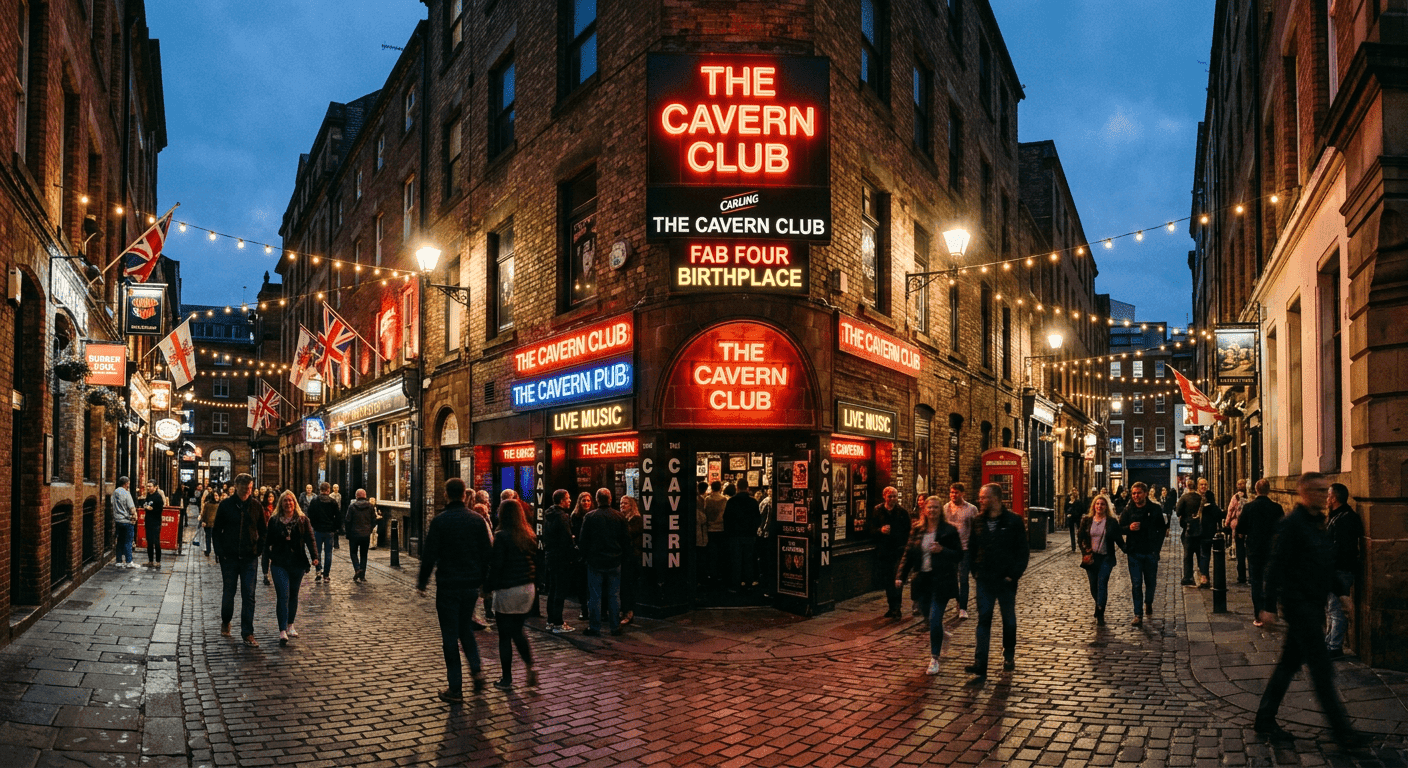
Few music venues carry the mythology of the Cavern Club.
Hidden beneath Mathew Street, the venue opened in January 1957 as a jazz cellar before gradually transforming into the spiritual home of Liverpool rock and roll. Damp walls, low ceilings, sweat-soaked crowds, and echoing brick tunnels created an atmosphere unlike anywhere else in Britain.
The Beatles played the Cavern 292 times.
It was there, during a lunchtime session in November 1961, that Brian Epstein first saw the band perform. That meeting would ultimately change music history.
The original Cavern closed in 1973 after British Rail purchased the site during construction of the Merseyrail underground loop. However, the club’s importance to Liverpool identity ensured it never disappeared for long.
The venue reopened in reconstructed form during the 1980s and continues to operate today, hosting live music almost every day of the week.
Outside, statues of Cilla Black and John Lennon now stand among tourists, buskers, tribute acts, and music fans from every corner of the globe.
Few cities preserve their musical mythology quite like Liverpool.
Punk, Post-Punk, and the Reinvention of Liverpool Music
By the late 1970s, Liverpool’s music scene reinvented itself once again.
The polished harmonies of Merseybeat gave way to something darker, stranger, and more experimental. Economic decline, unemployment, and social tension helped fuel a new creative movement centred around Eric’s Club on Mathew Street.
The venue became the beating heart of Liverpool’s punk and post-punk explosion.
Echo and the Bunnymen emerged as one of the defining bands of the era, blending atmospheric guitars, poetic darkness, and cinematic ambition into albums such as Crocodiles and Ocean Rain. Their song “The Killing Moon” became one of the most iconic tracks of the 1980s.
At the same time, Liverpool produced an extraordinary range of artists pushing music in completely different directions:
- OMD helped pioneer synth-pop
- Frankie Goes to Hollywood shocked Britain with “Relax”
- The Teardrop Explodes fused psychedelia and post-punk
- Dead or Alive brought flamboyant dance-pop into the mainstream
- A Flock of Seagulls carried Liverpool’s sound into the MTV generation
- China Crisis and The Mighty Wah! added sophistication and melody to the city’s evolving scene
Liverpool no longer sounded like the Beatles, but the city’s instinct for innovation remained exactly the same.
Britpop, Indie, and the Liverpool Sound of the 1990s
Liverpool entered the 1990s with another generation ready to leave its mark.
The La’s created one of British indie music’s defining songs with “There She Goes”, a record whose jangling melody and emotional simplicity became timeless. Despite their turbulent history, the band’s influence on British guitar music remains enormous.
Cast followed with huge commercial success during the Britpop era, while The Farm blended indie rock and dance culture into an unmistakably early-1990s sound.
Elsewhere, Space brought eccentric storytelling and cinematic flair to the charts, while the Boo Radleys expanded psychedelic guitar music into something warmer and more expansive.
Liverpool once again proved capable of reinventing itself without losing its identity.
A New Millennium of Liverpool Artists
The 2000s introduced yet another wave of musicians carrying Liverpool music into new territory.
The Coral emerged with a sound that felt deeply rooted in the city’s musical past while still sounding entirely modern, blending folk, psychedelia, garage rock, and surreal storytelling.
The Zutons injected saxophone-driven energy into British indie music, while the Wombats built an international following through sharp songwriting and explosive live performances.
Liverpool’s electronic and alternative scenes also flourished:
- Ladytron gained a worldwide cult following
- Clinic developed one of British indie’s most distinctive aesthetics
- Circa Waves brought festival-ready guitar music into the streaming era
- She Drew The Gun fused politics, poetry, and psychedelia
Meanwhile, Liverpool rap developed its own identity, with artists such as Tremz, Aystar, and Hazey embracing strong Scouse accents and hyper-local storytelling.
Even as music technology changed dramatically, Liverpool continued producing artists with a powerful sense of place.
The Baltic Triangle and Liverpool’s Modern Music Underground
Modern Liverpool music stretches far beyond the Cavern Club.
The Baltic Triangle has become one of the UK’s most important creative districts, transforming former industrial warehouses into studios, clubs, bars, rehearsal spaces, and independent venues.
Places such as:
- Invisible Wind Factory
- Camp and Furnace
- Kazimier Stockroom
- Jacaranda Baltic
- District
- Quarry
have helped create a new ecosystem for independent artists and promoters.
At the same time, major venues such as the M&S Bank Arena continue attracting international touring acts, while the Eurovision Song Contest in 2023 showcased Liverpool’s musical identity to a global television audience.
Liverpool remains a city where grassroots culture and global spectacle exist side by side.
The Soundtrack of the City
Music in Liverpool is not confined to venues.
It spills out of pubs, football grounds, taxis, record shops, universities, barber shops, ferry terminals, and late-night kitchens. It exists in terrace chants, family memories, old rehearsal rooms, local accents, and stories passed between generations.
“You’ll Never Walk Alone”, recorded by Gerry and the Pacemakers in 1963, became more than a football anthem. It became part of the emotional language of the city itself.
Liverpool’s musical culture is woven into everyday life in a way few places can replicate.
Liverpool’s Legacy Lives On
What makes Liverpool extraordinary is not simply the number of successful musicians it has produced.
It is the continuity.
Each generation builds upon the last:
- Skiffle became Merseybeat
- Merseybeat inspired punk
- Punk fed indie
- Indie shaped alternative and electronic music
- New artists continue emerging from the same streets, clubs, rehearsal rooms, and communities
The city never stopped creating.
Today, institutions such as LIPA, co-founded by Paul McCartney, help nurture new generations of performers, producers, and songwriters. Independent labels, grassroots venues, and a fiercely loyal local audience continue supporting emerging talent despite the challenges facing modern music scenes across the UK.
Liverpool does not preserve music as nostalgia alone.
It lives it.
From the echoing brick arches of the Cavern to warehouse venues in the Baltic Triangle, the city continues doing what it has always done best, turning working-class creativity into music that reaches every corner of the world.