Liverpool’s Living Clocktower
Stand on Liverpool’s Pier Head and look up at the clock. If anywhere in the city feels like it’s watching back, it’s here.
The Royal Liver Building is part office block, part myth, part early skyscraper experiment — and still one of the clearest ways to understand how Liverpool sees itself: maritime, modern, stubbornly independent, and just a bit enchanted.
It is a building built to be seen, but also a building built to mean something.
Built for the People, Not the Palace
What makes the Liver Building unusual is who it was built for.
It wasn’t commissioned by a King, a shipping dynasty or an aristocrat flexing status.
It was built for ordinary working families.
Royal Liver Assurance began as a mutual society — a fund to protect everyday people in tough times. By the early 1900s they had thousands of members across the region. When they needed a HQ, they didn’t choose a safe little brick block. They chose the waterfront. And they chose big.
Construction began in 1908. The doors opened in July 1911. On time. On budget. And decades ahead of anything else in Britain in concrete, ambition and scale.
Where London played safe, Liverpool went experimental.
This wasn’t ego architecture.
This was community ambition cast in concrete.
One of the World’s First Concrete Giants
The Liver Building is not just old — it was radical for its time.
It was one of the first buildings on Earth to use reinforced concrete on this scale. Before most British cities even trusted steel frames, Liverpool poured a skyscraper out of literal modern invention.
At roughly 100 metres tall, it briefly stood among the tallest buildings in all of Europe. Not a cathedral. Not a palace. A working building for a mutual society.
And its look?
Hard to classify.
Not Edwardian Baroque.
Not American Beaux-Arts.
Not quite Deco.
It’s Liverpool Modernism before the word even existed — a bold, ocean-facing tower of concrete and confidence.
A proto-skyscraper — in a port city — in 1911.
That’s how bold Liverpool was.
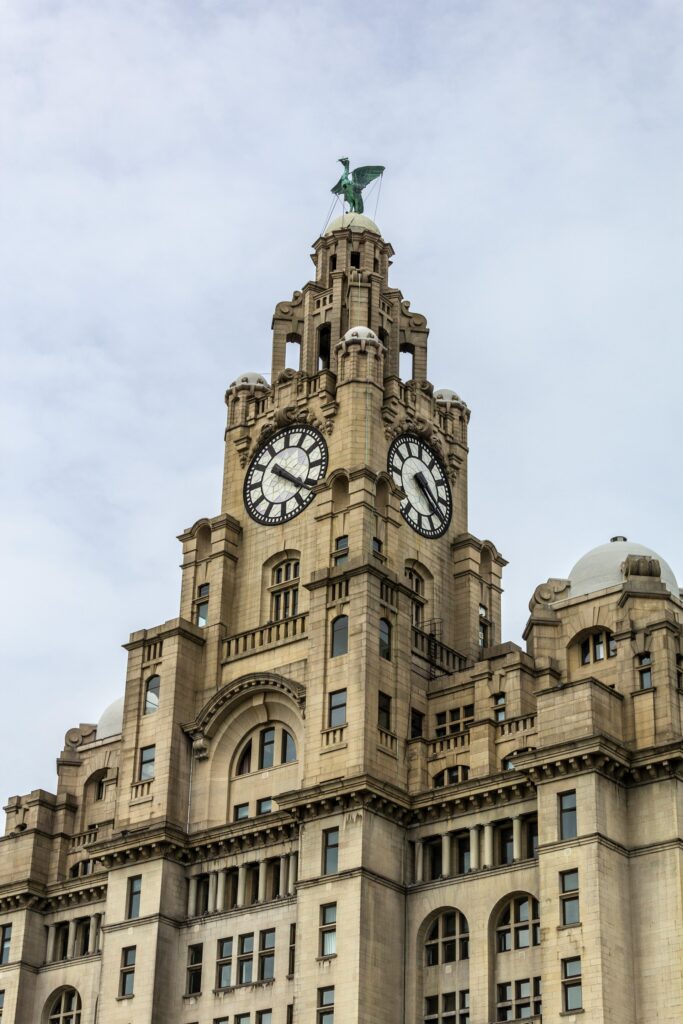
The Clocks That Outshine Big Ben
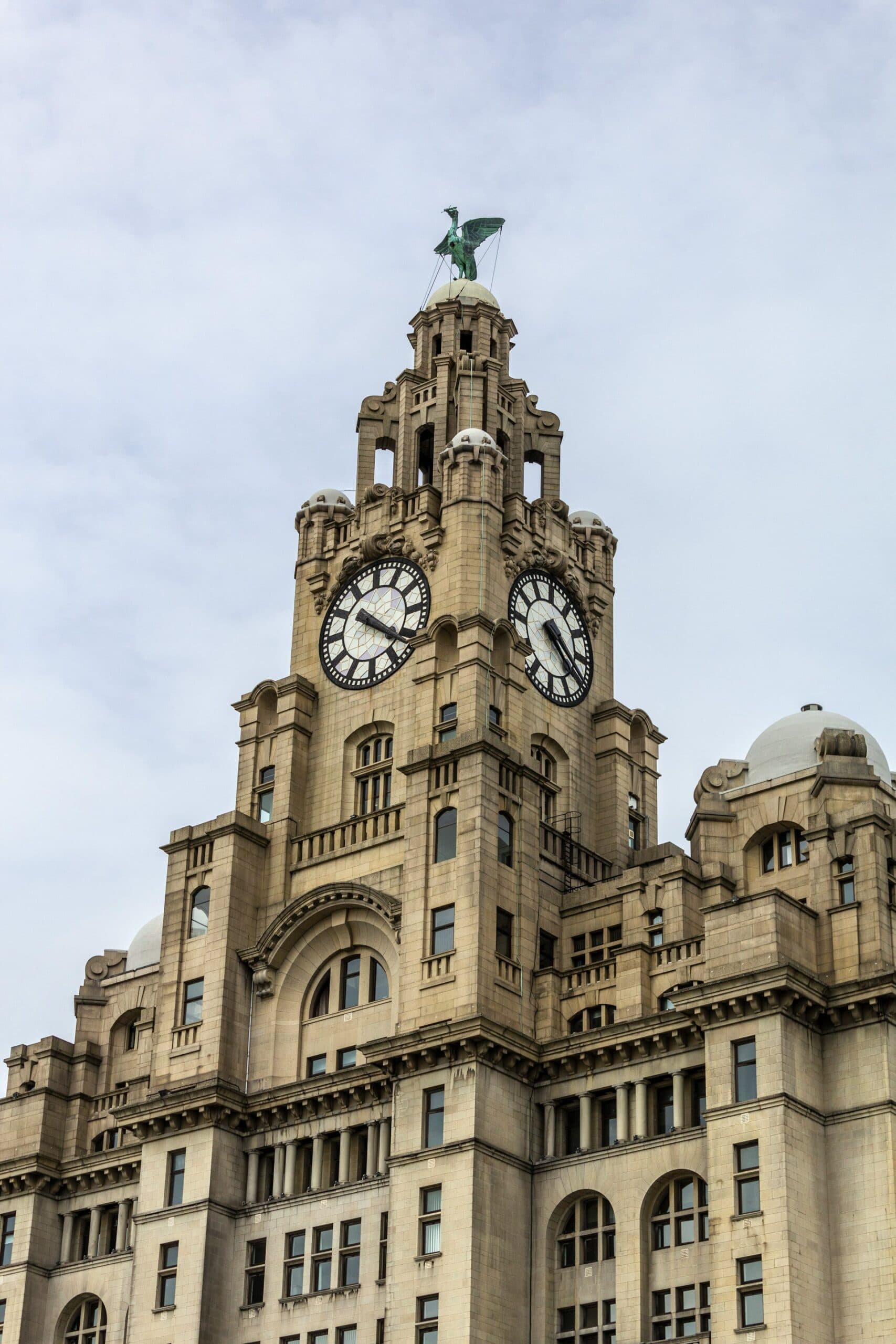
Most people don’t realise this — but the four clocks on the Liver Building are bigger than Big Ben.
Each clock face is over seven metres wide.
Built not to decorate — but to serve.
These clocks were industrial timekeepers.
Dockers. Sailors. Office clerks. Ticket masters. Bank tellers.
Liverpool didn’t need “pretty”.
Liverpool needed precision.
They were switched on for the coronation of King George V in 1911 — and for more than a century, their quiet job has been to keep the city moving on time.
And yet… there’s romance in them too.
Because every second they tick is a reminder:
Liverpool has always been a city that keeps pace with the world — not follows it.
The Liver Birds: Myth on a Steel Frame
High above the clocks sit two copper creatures the world calls Liver Birds — but here’s the real magic:
Liverpool invented their personality.
One bird faces the river — guarding the sailors and the coming ships.
The other faces the city — watching over the people.
And every Scouser knows the folklore line:
If the birds ever fly away — Liverpool falls.
It’s myth.
It’s humour.
It’s grit.
And it’s exactly the kind of playful seriousness that defines this city.
They’re chained down physically because of storms and sea wind.
But they’re chained down emotionally because Liverpool refuses to let go of its symbols.
They are the guardians of a city that has always fought for itself.
A War-Tested, Working Landmark
Through two World Wars, the rise and fall of the docks, the city’s economic storms — the Liver Building didn’t become a museum piece.
It kept working.
The clocks still ran.
Phones still rang.
Paperwork still piled on real desks.
In the 1950s, the building’s bells were electrified — not as a gimmick — but as a memorial to Royal Liver members who never came home.
It’s a reminder that this building isn’t just an icon to be photographed.
It’s a place where people lived their actual days, earned wages, paid premiums, planned futures.
The Liver Building is a monument because it never stopped being useful.
Beauty and purpose — fused in concrete.
Ownership, Capital and Continuity
The Liver Building’s story also charts who holds power in Liverpool.
It began as a headquarters for a mutual society — owned in spirit by working people.
Later, it became a prized global real estate asset — sold, bought, financed, traded.
But here’s the twist:
In recent years, local business has returned to its heart.
Liverpool companies occupy its floors, modern brands use its meeting rooms, and heritage tours now guide visitors to the top.
This building has passed through money, markets and management.
Yet it remains rooted in the one constant force that built it:
the people of Liverpool.
Its value is no longer just insurance policies and office leases.
Its value is emotional and cultural — something the city refuses to surrender.
The Three Graces and the Meaning of the Waterfront
Side by side with the Cunard Building and the Port of Liverpool Building, the Liver Building forms the famous waterfront trio known as The Three Graces.
Together, these three structures tell the story of Liverpool’s golden age of global trade:
- one for goods
- one for ships
- one for people
But the Liver Building is the emotional centre — because of those birds.
It carries the weight of the city’s confidence.
It carries the punchline of its humour.
It carries the quiet pride of a working port that rose above the odds.
These buildings are not just façades.
They are Liverpool’s own mythology written in stone and concrete.
When visitors arrive by river, the first thing they face is this — three towers standing like guardians on the edge of the Irish Sea.
This isn’t a postcard.
This is identity.
Why the Liver Building Still Matters Today
Look at your photo again — the clock, the wings, the sky behind them.
That image isn’t nostalgia.
It’s continuity.
In a world of temporary glass towers and disposable cities, the Liver Building still does what it was always built to do:
- protect the city’s confidence
- anchor the waterfront skyline
- remind Liverpool who it is
It was an early skyscraper before skyscrapers.
It was built for people before brands.
It holds myth without embarrassment.
And it still stands.
The Royal Liver Building endures because it is more than architecture — it is a manifestation of Liverpool’s character:
bold, warm, imaginative, tough and unashamed of where it came from.
Liverpool built a skyscraper in 1911.
Today, the world is still catching up.
Today, the Royal Liver Building isn’t just a landmark to admire from the waterfront, you can actually go inside. The tower now offers the Liver Building 360 experience, allowing visitors to step into the historic clocktower, climb above the city and stand almost eye-to-eye with the Liver Birds. It’s not just a tour, it’s a way to feel the mythology, the architecture and the skyline all at once. If you’re in Liverpool, this isn’t just something to do, this is the one Liverpool view that tells the whole story.
Royal Liver Building 360 Tour
Times and opening hours vary throughout the year — please check online for the latest availability.
Prices:
Adult (16+) – £17.50
Child (5–15) – £12.50
Children under 5 are not permitted on the tower tour.
All online bookings carry a £1.75 administration charge per booking (not per ticket).
The full experience lasts around 70 minutes, plus additional time to explore the visitor centre. The attraction opens 30 minutes before the first tour each day so you can collect tickets and enjoy the archive displays before heading up.
Please note: the tower involves climbing 124 stairs above the 10th floor, so please read the full accessibility information before booking.
Book your tickets and check tour times here:
https://liverbuildingtour.com/how-to-find-us/